
Episode 293 · 2024-12-25 · 52:39 · Original in Finnish
Power Struggles in Finland’s Industrial Elite | Marko Junkkari | Neuvottelija 293
Originally published as “Vuorineuvosajan valtasekoilut | Marko Junkkari | Neuvottelija 293”
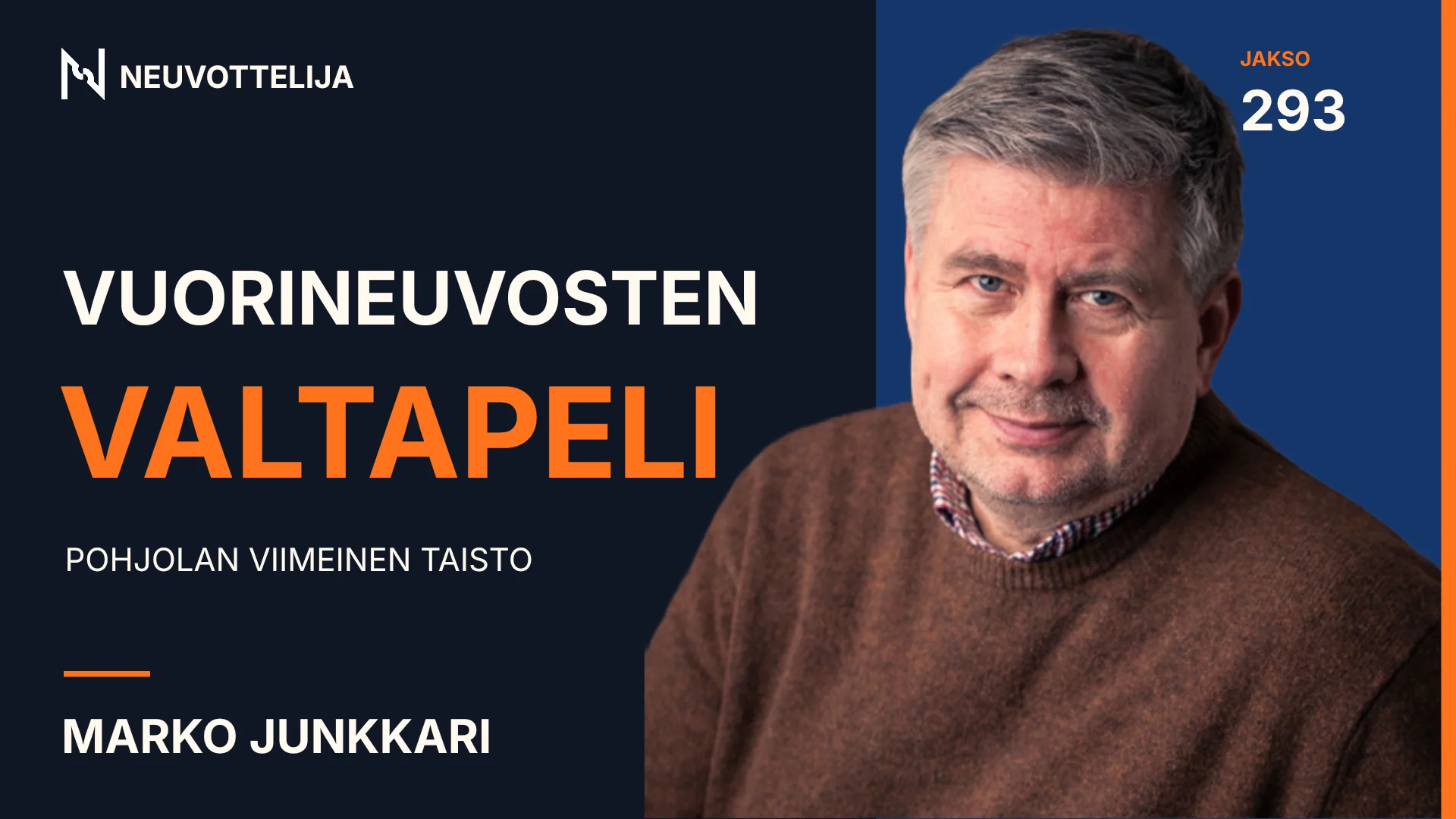
Marko Junkkari discusses Pohjola’s ownership battles and his book Vallan linnakkeen viimeinen taisto. The conversation examines interconnected institutional owners, the Conventum acquisition, Eero Heliövaara’s leadership, the sale to OP and the question of what replaced Finland’s old industrial elite.
Core theses
- Interconnected ownership and board roles concentrated authority in Finland’s established corporate groups.
- The Conventum acquisition reshaped both Pohjola’s business and its balance of power.
- Junkkari describes the emphasis on the combined ratio as a change in the relationship between policyholders and shareholders.
- The speakers differ in their assessment of the active ownership that followed the old institutional arrangements.
Watch and listen
The history of an insurance company can reveal how an entire economy distributes power. In Vallan linnakkeen viimeinen taisto – Kertomus vakuutusjätti Pohjolan lopusta (Otava, 2024), journalist Marko Junkkari examines the end of Pohjola as an independent company through a question of ownership: who determines a company’s direction, whose money are they using, and who holds them accountable?
In Neuvottelija 293, Junkkari and Sami Miettinen discuss Pohjola’s ownership battles and Finland’s transition from the spheres of influence of banks and insurers to more open capital markets. They also ask whether active ownership became stronger as the old arrangements dissolved. The interview was published on 25 December 2024; its assessments reflect the time of the conversation.
Pohjola’s fortress of ownership
Junkkari says he set out to write about ownership. Groups organised around the major banks had long influenced Finland’s largest companies. As the banking sector consolidated, insurance companies became more prominent owners. Pohjola, the life insurer Suomi and the pension insurer Ilmarinen formed an interconnected group whose ownership and governance relationships made it difficult for outsiders to challenge. (01:14, 06:13)
Insurance generated funds for investment because considerable time could pass between collecting premiums and paying claims. Investments brought board seats and influence. Junkkari focuses on Yrjö Niskanen’s position: the same individual could exercise power within the company and within the governance of its shareholder. Management’s authority and oversight of management became intertwined. (06:41–08:02)
This is the world the interview calls the vuorineuvos era, referring to Finland’s established industrial elite. Strong personalities mattered, but so did the structure connecting owners, financiers and executives. Challenging a particular decision meant confronting a much wider network.
New owners expected different governance
Junkkari connects the change to the opening of Finland’s markets in the 1990s and the arrival of foreign investors. New shareholders expected clearer governance and a stronger focus on their interests alongside the personal relationships on which the old system relied. Pohjola’s established practices came under pressure. (11:13–12:20)
In Junkkari’s account, Iiro Viinanen was tasked with reforming the company’s governance. Junkkari separates the purpose of the changes from their execution: reform was justified, but implementing it within a divided organisation proved unsuccessful. An expectation that decisions would be carried out with the loyalty familiar from a government ministry did not fit Pohjola’s internal power struggles. (12:15–13:58)
Changing formal governance arrangements is only part of the task. The owners’ objectives, the board’s responsibilities and management’s ability to act also have to align in practice.
The Conventum acquisition changed who held power
The conversation examines Pohjola’s acquisition of Conventum in 2001 both as a business transaction and as a response to a deadlock among its owners. Junkkari says he had previously been highly critical of the deal, but researching the book led him to qualify that assessment. (14:57)
Ilmarinen, Suomi and the OP banking group held different views about Pohjola’s future. In Junkkari’s interpretation, the Conventum transaction offered a way out of that impasse. Eero Heliövaara became Pohjola’s chief executive and Peter Fagernäs its chairman. Junkkari resists the simple explanation that the sequence amounted solely to Heliövaara engineering his own advancement. (18:52–20:23)
A transaction can have a commercial rationale while also redistributing authority. It changes products and customer relationships, but also determines who will make the next set of decisions. Those dimensions repeatedly overlap in Pohjola’s story.
Who should receive an insurer’s returns?
The combined ratio provides a way into the changes under Heliövaara. It relates the costs of insurance operations and claims to insurance revenue. Junkkari describes the increased emphasis on the measure as a change in philosophy: underwriting should be profitable in its own right, while investment returns were increasingly treated as returns for shareholders. (21:58–23:12)
The discussion connects operating performance to the purpose of ownership. Customers, policyholders and shareholders do not necessarily want the same outcome. The measure management chooses reveals which objective it prioritises and how it directs the organisation.
Ilmarinen, meanwhile, had a particular interest in retaining its insurance distribution channel. Junkkari presents this as an explanation for decisions that can be hard to understand if viewed simply as equity investments. Ownership could protect the continuity of another business. (23:56)
What the owner knew and management did not
The book’s account of Pohjola’s sale to OP makes the relationship between information and power explicit. According to Junkkari, Kari Puro worked on a sale for a long period without Heliövaara’s knowledge. Heliövaara learned the full duration of the negotiations only during the book’s preparation. This is Junkkari’s account of the events as presented in the interview. (36:54–38:02)
The subsequent minority-shareholder dispute over the price illustrates a second imbalance. Large shareholders can determine a company’s direction even when smaller owners assess the terms differently. Junkkari discusses this as a practical problem of ownership. (38:02–39:53)
What replaced the industrial elite?
Towards the end, the conversation turns to Finland’s ownership structure. Junkkari describes an economy in which institutions accumulated considerable influence partly because there were relatively few substantial individual owners. Miettinen questions whether enough active ownership emerged after the old spheres of influence broke up. His assessment of pension investment and the incentives for ownership is critical. (43:07–47:41)
Junkkari adds a different development: individual investing grew strongly in Finland during the second half of the 1990s. The dismantling of the old system also created opportunities. The speakers differ in how much weight they give that progress. (49:04)
Pohjola’s history leaves a question that extends beyond one company: how can an owner’s authority, responsibility and personal incentives be brought together? An independent board needs expertise and a clear understanding of whose interests it serves.
The book’s perspective and the related interview
Junkkari describes the book’s origins and sources openly. Heliövaara and Puro had suggested the subject to the publisher, but Junkkari says he had editorial freedom. Alongside interviews with the central figures, he used Pohjola’s board minutes. He says he deliberately tried to avoid hindsight. (32:25–33:21, 50:26)
The interviewer’s background is also relevant: Miettinen says he began his investment-banking career under Fagernäs and later received a job offer from Conventum. (13:58, 17:44)
The related Insider 86: Conventum Fagernäs vs Mandatum Wahlroos continues into the rivalry between the two figures. It is a Finnish-language YouTube members-only episode recorded during the same visit. This article is based on the public main episode and its cleaned Finnish subtitles.
Watch Neuvottelija 293. Book information: Otava. Junkkari’s earlier visit: Neuvottelija 196.
Go deeper
People and topics
Guests: Marko Junkkari
Topics: Ownership, Capital & Tax Leadership & Governance Finnish Economy & Policy