
Influence authority profile · pilot · v1.1
Robert Cialdini: Seven Principles of Influence and the Power of Pre-Suasion
Authority: Robert B. Cialdini · Canonical works: Influence: The Psychology of Persuasion · Pre-Suasion: A Revolutionary Way to Influence and Persuade
Editorial note. This is an independent analysis of Robert Cialdini’s theories, not a reproduction or substitute for Influence or Pre-Suasion. It distinguishes Cialdini’s claims from Neuvottelija’s synthesis and links verifiable claims to official or scholarly sources.
A London encounter, 13 June 2006

I attended the London seminar while living in the City and enjoyed Cialdini’s practical, evidence-led account of influence. During my London investment-banking years, my roles included Credit Suisse, JP Capital/Pöyry Capital and SEB. I applied Cialdini’s framework—now expressed as seven principles—to investment-banking negotiations: preparing authority evidence, using relevant social proof, understanding scarcity and reciprocity, and designing commitments that could survive beyond the meeting.
The core claim: influence is an architecture of yes
Robert Cialdini’s enduring contribution is not a list of sales tricks. It is a model of decision shortcuts. Human beings cannot fully analyse every request, person and signal. We therefore use recurring cues to decide what deserves trust, attention and action. Cialdini’s framework names seven: reciprocity, commitment and consistency, social proof, authority, liking, scarcity and unity. His official presentation describes them as widely used shortcuts that should be employed ethically, not as guarantees that compel behaviour.
The two central books address different moments:
- Influence asks: What makes a request more likely to receive yes?
- Pre-Suasion asks: What determines the state of mind in which the request is received?
This distinction matters. A message does not enter an empty mind. It arrives after a sequence of questions, images, comparisons, identities, expectations and emotions. Influence works at the request. Pre-suasion works on the runway before it.
The seven principles
| Principle | Mechanism | Ethical application | Defensive question |
|---|---|---|---|
| Reciprocity | We feel pressure to return value, concessions or care received from others. | Give useful value without disguising an obligation; make concessions that genuinely move the solution. | Was this freely given, or is a small gift being used to manufacture a disproportionate debt? |
| Commitment and consistency | We prefer actions that fit what we have already said, chosen or publicly supported. | Begin with a voluntary, relevant commitment and make later steps consistent with it. | Am I continuing because the next step is good, or merely because I already said yes? |
| Social proof | Under uncertainty, other people’s behaviour becomes evidence about what is normal or effective. | Show truthful behaviour from a relevant comparison group. | Are these people genuinely comparable to me, and is the evidence representative? |
| Authority | Expertise, credentials and legitimate responsibility reduce uncertainty. | Make relevant competence and its limits visible before making the case. | Does this authority have expertise here, and is the claim inside that expertise? |
| Liking | Similarity, familiarity, cooperation and genuine appreciation lower interpersonal resistance. | Find real common ground and work toward a shared objective. | Would I accept the same proposal from someone I did not like? |
| Scarcity | Limited availability and potential loss increase perceived value and urgency. | State real constraints, deadlines and opportunity costs precisely. | Is the scarcity real, decision-relevant and independently verifiable? |
| Unity | A salient shared identity can turn another person’s outcome into part of our own. | Activate a genuine, inclusive identity connected to the task. | Is belonging being used to prevent scrutiny, dissent or exit? |
The official principles overview presents all seven. Earlier editions of Influence became famous for six; unity appears as the seventh in Cialdini’s later formulation and the expanded edition.
Contrast is an amplifier, not an eighth destination
Judgment is relative. The same offer appears different after a different comparison, sequence or anchor. Contrast can amplify any of the seven principles: a moderate request after an extreme one, a normal price beside a premium reference, or a credible deadline beside an open-ended alternative.
Contrast is analytically useful because it reminds us that influence is rarely located in one sentence. It is distributed across the choice architecture: which option appears first, what comparison is available, which facts are grouped together and what is absent.
Pre-Suasion: the moment before the message
The official publisher’s description of Pre-Suasion states its central move clearly: successful persuaders prepare recipients to be receptive before presenting the message. Cialdini calls especially receptive windows privileged moments.
Attention changes perceived importance
What receives attention at the moment of choice often feels unusually important. A question about security makes risk more available. A story about belonging makes shared identity more accessible. A comparison with failure foregrounds loss. This does not prove that the attended factor is objectively most important; it means that attention can confer psychological priority.
Pre-suasion therefore has three practical layers:
- Attention: what is made salient immediately before the request?
- Association: what meanings, emotions and identities become connected to the request?
- Action channel: which of the seven influence principles fits the now-active state?
The ethical boundary is whether the preparation improves relevant understanding or diverts attention away from material facts. A safety question before a cybersecurity proposal can clarify the decision. Fear imagery that obscures cost, efficacy or alternatives can corrupt it.
Questions are directional
Questions do more than collect information. They direct search. Asking “What do you value in a long-term partner?” makes partnership criteria available. Asking only “How much could you save this quarter?” narrows attention toward price. An ethical pre-suasive question surfaces a real decision criterion; a manipulative one hides competing criteria that the decision maker should also consider.
Environments persuade
Web interfaces, room layouts, agendas, visuals, timing and speaker order all decide what becomes easy to notice. Digital systems intensify this because interfaces can continuously test which sequence, prompt or cue produces action. The important unit of analysis is not only the copy. It is the whole environment that precedes and surrounds the choice.
What the evidence supports
Cialdini’s framework is a practical synthesis of a broad social-influence literature, field observation and experiments. The scholarly review by Cialdini and Noah Goldstein organises compliance and conformity research around central human goals such as accuracy, affiliation and maintenance of a positive self-concept.
Field work also demonstrates that apparently small contextual changes can matter. In two hotel field experiments, Goldstein, Cialdini and Griskevicius tested different social-norm messages intended to increase towel reuse. The value of this example is not that one sentence works everywhere. It is that the relevance of the reference group and the framing of observed behaviour can change compliance in a real setting.
The framework should still be used with four cautions:
- A taxonomy is not a deterministic law. Naming a cue does not establish how large its effect will be in a particular context.
- Effects are conditional. Culture, relationship, stakes, prior beliefs, channel, timing and the credibility of the cue all matter.
- The principles overlap. A respected colleague’s recommendation may activate authority, liking, social proof and unity simultaneously.
- Evidence quality is heterogeneous. The broad mechanisms have extensive literatures, but individual demonstrations, examples and proposed mediators do not all carry equal evidential weight.
The best operating rule is modest: use Cialdini as a diagnostic map and hypothesis generator, then measure outcomes, seek disconfirming evidence and avoid promising universal effects.
Strengths
1. A memorable common language
The principles let teams discuss influence without resorting to vague claims about charisma. “We lack authority evidence” or “this social proof is from the wrong reference group” is more actionable than “make it persuasive.”
2. Defence as well as application
Each mechanism can be reversed into a protective question. This is crucial: Influence is useful not only for winning assent but for recognising when one’s own assent is being engineered.
3. Field realism
Cialdini deliberately connects laboratory mechanisms to the work of salespeople, fundraisers, recruiters, advertisers and other practitioners. The framework stays close to observable behaviour.
4. Timing
Pre-Suasion moves analysis upstream. It asks who designed the agenda, question, comparison and emotional state before the visible decision. This is especially valuable in politics, media and algorithmic environments, where influence often occurs through selection and sequencing rather than explicit argument.
Blind spots and limits
It explains assent better than value creation
Cialdini helps explain why people say yes. It says less about whether the available agreement is the most useful one, whether new options could satisfy both parties better, or whether the implementation system can deliver the promise.
It usually treats a focal persuader and recipient
The real world also contains institutions, coalitions, algorithms, network effects, repeated games and actors who set the rules without making a direct request. A future Influence Power model must move from the dyad to the system.
Ethical labels do not enforce ethical behaviour
Calling a principle ethical is not enough. Real scarcity can still be exploited; real authority can overreach; genuine unity can suppress dissent. Ethical influence needs observable constraints: truthful claims, proportionality, disclosure where material, freedom to refuse and accountability for consequences.
Attention can improve or degrade decisions
Pre-suasion can foreground a neglected, relevant criterion. It can also crowd out better criteria. The test is not whether attention moved; it is whether the resulting decision remained informed and contestable.
Dark influence and defence
The seven principles also provide a compact threat model:
- fabricated social proof creates a false crowd;
- rented status simulates authority;
- false countdowns manufacture scarcity;
- trivial gifts create unwanted obligations;
- staged similarity manufactures liking;
- escalating micro-commitments trap people in sunk-cost consistency;
- identity pressure reframes dissent as betrayal.
A practical defence protocol is Stop—Separate—Verify—Reverse:
- Stop: insert time between cue and decision.
- Separate: evaluate the proposal apart from the person, gift, crowd or deadline.
- Verify: check evidence, authority, scarcity and reference groups independently.
- Reverse: ask whether you would accept the method if the other side used it against you.
This protocol does not make a person immune. It restores the missing deliberative step.
Bridge to New Negotiation Power
Cialdini’s framework and New Negotiation Power are complementary, not interchangeable.
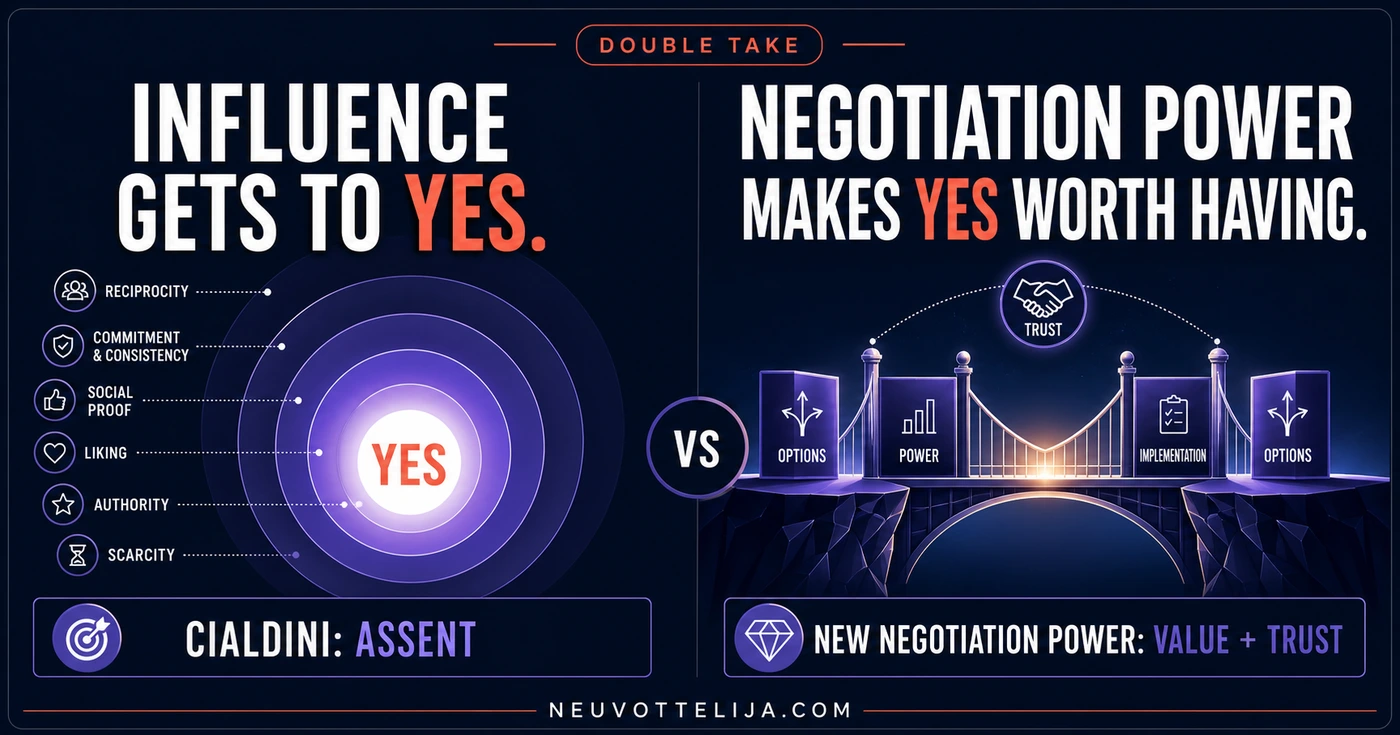
Cialdini explains how influence increases the probability of “yes”. New Negotiation Power asks the harder question: is that “yes” actually worth having?
Influence shapes attention, trust and assent. Negotiation Power adds alternatives, value creation, implementation and the long-term Trust Account.
The two frameworks are complementary, but they optimize for different outcomes.
| Cialdini | New Negotiation Power | Relationship |
|---|---|---|
| Reciprocity, liking, social proof, unity | Interaction | The strongest overlap: signals, emotions, acceptability, trust and the human reception of an agreement. |
| Authority and scarcity | Power | Authority changes credibility; scarcity changes alternatives and urgency. Negotiation Power adds mandate, BATNA, time, direct power and indirect power. |
| Commitment and consistency | Principles | Prior commitments can stabilise behaviour. Negotiation Power adds ethics, implementation, reputation and the long-term Trust Account. |
| Pre-suasive attention and sequencing | Dialogue Planning | Both insist that decisive work happens before the visible meeting or request. |
| Persuasive request design | Analytics | Cialdini helps package and present. Analytics adds needs, criteria, scenarios, option creation and joint gain. |
Sami Miettinen’s synthesis
My strongest bridge between the two models is this: influence should be prepared as carefully as the economics of the agreement.
In negotiation, Cialdini’s principles should not be bolted onto a weak proposal at the end. They belong in Dialogue Planning:
- identify the relevant authority evidence before the meeting;
- decide which reference group makes social proof meaningful;
- make real constraints visible without manufacturing pressure;
- surface genuine shared identity without demanding conformity;
- sequence questions so needs become visible before positions harden;
- plan how every commitment will be implemented and recorded;
- test whether the tactic deposits into or withdraws from the Trust Account.
This yields a four-part ethical influence test:
- Truth: Is the cue factually real?
- Relevance: Does it help evaluate the actual decision?
- Proportionality: Is the requested response proportionate to the cue?
- Reversibility: Would we accept the same method from the other party?
If one answer is no, the technique may still produce assent, but it no longer meets the standard of principled influence.
Practical exercise: audit one request
Choose a real request—a proposal, fundraising appeal, sales page, public statement or meeting agenda—and score it:
| Question | Evidence to record |
|---|---|
| What state of mind is created before the request? | Opening question, image, comparison, agenda item, emotional cue |
| Which principles are activated? | Reciprocity, commitment, social proof, authority, liking, scarcity, unity |
| Which cues are real and relevant? | Sources, credentials, comparable groups, actual constraints |
| What material information is outside attention? | Cost, alternatives, risks, dissenting evidence, exit |
| What protects freedom of choice? | Time, disclosure, reversibility, right to refuse |
| What happens to long-term trust? | Expected deposit or withdrawal from the Trust Account |
Then revise the request to improve both persuasiveness and decision quality. The goal is not maximum compliance. It is informed, durable commitment.
What transfers into the Influence research programme
Cialdini contributes five building blocks:
- influence often operates through reusable decision shortcuts;
- timing and attention before the message can be as important as the message;
- the same mechanism can support ethical coordination or manipulation;
- defence can be designed by making the mechanism visible;
- small changes in words, actions, images and environments can alter behaviour.
The open research questions are equally important:
- How do these mechanisms scale from individuals to audiences and institutions?
- How do algorithms automate pre-suasion by selecting what becomes salient?
- When does unity build cooperation, and when does it become identity coercion?
- How should influence be measured when assent, welfare and long-term trust diverge?
- Which principles survive when the audience knows exactly what is being attempted?
Sources and further reading
- Robert B. Cialdini, Influence: The Psychology of Persuasion, new and expanded edition (Harper Business, 2021), listed in Cialdini’s official curriculum vitae.
- Robert B. Cialdini, Pre-Suasion: A Revolutionary Way to Influence and Persuade (Simon & Schuster, 2016).
- Influence at Work, The Seven Principles of Persuasion.
- Robert B. Cialdini and Noah J. Goldstein, “Social Influence: Compliance and Conformity”, Annual Review of Psychology 55 (2004), 591–621.
- Noah J. Goldstein, Robert B. Cialdini and Vladas Griskevicius, “A Room with a Viewpoint: Using Social Norms to Motivate Environmental Conservation in Hotels”, Journal of Consumer Research 35:3 (2008), 472–482.
- Robert B. Cialdini and Jennifer L. Eberhardt, discussion of the seven principles and applied psychological science, Association for Psychological Science (2021).
Where to go next
- Influence research library — the common analysis frame and future authority profiles
- New Negotiation Power — Power, Analytics, Interaction and Principles
- Negotiation Strategy, Leverage and Power — applying the model against hard counterparties
Frequently asked questions
What are Cialdini's seven principles of influence?
Reciprocity, commitment and consistency, social proof, authority, liking, scarcity and unity. They are recurring decision shortcuts that can increase the probability of assent when they are relevant and honestly activated; they are not deterministic laws or substitutes for a valuable proposal.
What is the difference between Influence and Pre-Suasion?
Influence primarily maps mechanisms that make a request persuasive. Pre-Suasion focuses on the moment before the request: how attention, associations, questions and context can make certain considerations unusually accessible when a decision is made.
Is Cialdini's framework manipulation?
The mechanisms can be used ethically or manipulatively. Ethical use relies on truthful evidence, genuine similarity, real scarcity, proportionate requests and preserved freedom to refuse. Fabricated cues or concealed pressure exploit the same mechanisms and damage trust.
How does Cialdini connect to New Negotiation Power?
Cialdini is strongest inside the Interaction dimension: signalling, acceptability, attention and emotion. His authority, scarcity and unity principles also touch Power and Principles. New Negotiation Power adds alternatives, mandate, value creation, package design, team roles, implementation and long-term trust.
What is a privileged moment in Pre-Suasion?
It is a moment when a person is unusually receptive to a message because a relevant idea, identity or concern has been elevated in attention. The concept warns that what is salient at decision time can feel more important than considerations that are equally or more relevant but less accessible.
← Influence library · Markdown mirror: index.md