---
title: "Private equity in Finland: active ownership, growth and AI-assisted investor relations"
description: "A practical guide to venture capital, growth and buyouts, ownership economics, risks and investor communication — with Pia Santavirta’s Neuvottelija 94 interview and Sami Miettinen’s March 2026 FVCA workshop."
keyword: "private equity in Finland"
datePublished: 2026-09-13
dateModified: 2026-09-13
authors: ["Sami Miettinen"]
canonical: https://www.neuvottelija.com/guides/private-equity-finland-active-ownership-and-ai/
---
# Private equity in Finland: active ownership, growth and AI-assisted investor relations
Private equity is best understood as a form of ownership, not merely a source of money. The essential questions are what a company can become, what prevents it from getting there, and which combination of capital, people and governance can remove those obstacles. For a founder, that means choosing a partner as carefully as choosing a valuation. For a fund investor, it means examining the manager’s repeatable process rather than a compelling success story alone.
This guide combines general corporate-finance analysis with the themes of my conversation with **Pia Santavirta in Neuvottelija 94**. She represented the Finnish Venture Capital Association as its CEO at the time of the interview. The episode’s pandemic-era figures are historical observations, not a description of the market in 2026. The final section is my separate update on communications and practical AI work in 2026.
## Start with the conversation
**Leadership update, 13 September 2026:** Pia Santavirta is the association’s former CEO. The current CEO is **Anne Horttanainen**, according to the [FVCA team page](https://paaomasijoittajat.fi/yhdistys/tiimi/). **Riku Asikainen**, also a Neuvottelija guest, is the current chair, as confirmed by the [board page](https://paaomasijoittajat.fi/yhdistys/hallitus/).
[Watch the existing Finnish episode, with its publication metadata](https://www.neuvottelija.fi/fi/episodes/106-paaomasijoittaminen-eli-private-equity-pia-santavirta-neuvot), or [open Neuvottelija 94 on YouTube](https://www.youtube.com/watch?v=oj392t2pnbI). See also [Pia Santavirta’s guest page](/podcast/guests/pia-santavirta/).
Useful entry points are [04:16: angels, VC and buyout](https://www.youtube.com/watch?v=oj392t2pnbI&t=256s), [08:49: international capital](https://www.youtube.com/watch?v=oj392t2pnbI&t=529s), [23:44: ESG and impact](https://www.youtube.com/watch?v=oj392t2pnbI&t=1424s), [40:21: growth through acquisitions](https://www.youtube.com/watch?v=oj392t2pnbI&t=2421s) and [47:46: women and diversity in investment teams](https://www.youtube.com/watch?v=oj392t2pnbI&t=2866s). These chapter references come from the supplied episode description; this article is not a verbatim transcript.
## Angels, venture capital, growth and buyout are different tools
The Finnish term *pääomasijoittaminen* covers a broader field than the narrow English use of “private equity” to mean buyouts. Venture capital typically backs young companies with substantial uncertainty. Growth capital supports an established business entering another expansion phase. Buyout investors generally acquire control of a more mature company. The [FVCA’s introduction](https://paaomasijoittajat.fi/paaomasijoittaminen/tietoa-paaomasijoittamisesta/) describes these distinctions and the role of active ownership.
Angel investors commonly invest their own money, whereas a fund manager invests capital committed by its investors. That distinction affects decision-making, follow-on capacity and the timetable. A company should not approach every source of equity with the same proposal. A young business still searching for a repeatable sales model presents a different problem from a profitable company seeking a successor to its retiring founder.
The practical question is not which label sounds most attractive. It is whether the proposed investor’s strategy, ticket size, ownership preference and ability to fund the next stage fit the business. A minority investment may still come with significant approval rights. A majority transaction may leave the founder with a meaningful reinvestment and continuing operating responsibility. Read the actual terms.
## Follow the capital — and the incentives
In a conventional closed-end fund, institutional and other investors commit capital that the manager draws over time. The portfolio companies are one level of the system; the fund and its investors are another. A successful company sale does not by itself explain what an individual fund investor earned after the timing of capital calls, fees, expenses and carried interest.
These layers also explain why a transaction can have several objectives. Some money may finance the company’s expansion; some may purchase shares from existing owners. Distinguish primary capital from secondary proceeds. A founder selling shares and a company raising growth finance are not doing the same thing, even when both happen at the same closing.
Before accepting an offer, map the incentives: who controls the board, who approves major acquisitions, how management’s equity works, when additional capital may be needed and how an exit can be initiated. The headline valuation is only one part of the bargain. Governance and downside arrangements become most important precisely when the original plan stops working.
## Value creation must survive a difficult scenario
A credible investment case explains the operating changes that can make the business more valuable: stronger customer retention, better pricing, a more capable management team, improved working capital, a new market or a disciplined acquisition programme. Each claim needs an owner, a timetable and a way to measure progress.
Debt can amplify equity outcomes, but it does not create customer demand. Consider a deliberately simplified example: a business is bought for an enterprise value of €100 million, funded with €40 million of net debt and €60 million of equity. If enterprise value later reaches €130 million and net debt falls to €25 million, the equity value is €105 million. If enterprise value instead falls to €70 million while net debt remains €40 million, equity value is only €30 million. This illustration excludes fees, taxes, interest timing and distributions. It is arithmetic, not a forecast or a return promise.
The lesson is to distinguish operational improvement, debt reduction and changes in the valuation multiple. An investment should not require a more generous future buyer to make the plan credible. Stress-test slower growth, delayed acquisitions, weaker margins and refinancing pressure before celebrating the base case.
## International capital and buy-and-build
The interview discusses the limits of domestic fund sizes and the role of foreign capital in larger financing rounds. It also uses PHM and Kotikatu as a route into acquisition-led growth, and discusses Norvestor and Verdane in the context of international ambition. Those references describe the conversation at the time; they are not current investment recommendations.
For a company, the attraction of a cross-border investor should be more concrete than access to a larger cheque. Ask who can recruit local leadership, introduce customers, support integration and challenge an expansion plan. A network is valuable when it changes execution, not when it appears on a presentation slide.
Buy-and-build deserves particular discipline. Buying several companies does not automatically create one better company. Reporting, systems, incentives, customer relationships and leadership have to work together. Before a new acquisition, ask whether the previous one has been integrated and whether growth is generating cash rather than hiding deterioration in the original business.
## What the historical numbers do — and do not — show
The supplied episode description highlights 16 new VC funds, a pandemic-era record approaching €1 billion in startup investment, and a substantial private-equity background among Helsinki’s new listed companies. The conversation also addresses the removal of double taxation in funds-of-funds structures. These are attributed episode-era claims; they should not be reused as 2026 statistics or current tax advice.
The chapter title about stronger returns from PE-backed listings is a useful research question, not proof that every such listing outperforms. A comparison depends on the period, benchmark, sample and treatment of companies that disappear from the dataset. The same discipline applies to any claim that a particular ownership model reliably produces superior outcomes.
## ESG, impact and talent: ask for evidence
Santavirta and I discuss whether ESG and impact investing improve returns and how sustainability work affects access to finance. A useful way to examine this is to separate risk management from an intentional impact objective. A company can reduce a material environmental risk without making impact its primary investment thesis.
My practical test is whether an assertion changes decisions. Which exposure is material? What is the baseline? Who measures it? What action follows when the indicator deteriorates? Avoid replacing a business explanation with a generic score or assuming that an ESG label establishes causality between responsibility and returns.
The same applies to talent and diversity. The interview closes with skills, women in investment teams, role models and the courage to pursue opportunities. For an owner, recruitment is part of the investment case: expansion plans require people able to deliver them. A transparent recruitment process, a broader candidate pool and explicit accountability are more useful than a diversity statement detached from hiring and promotion.
## Investor relations is an operating process
Investor relations should make the ownership story inspectable. It connects performance, strategy, risk and capital allocation. A good programme defines audiences, responsibilities, reporting cadence, data sources, approval steps and escalation when something significant changes. It should also distinguish information intended for fund investors from public communications about the manager or portfolio companies.
As a separate reference, [Invest Europe’s investor-reporting guidance](https://www.investeurope.eu/investor-reporting-guidelines/introductory-guidance/) is a voluntary framework and does not replace applicable reporting obligations. Its [portfolio-information guidance](https://www.investeurope.eu/investor-reporting-guidelines/investment-portfolio-information/) calls attention to valuation inputs and methodology. Neither framework should be presented as an automatic certification of an AI-generated report.
For a practical first version, I would assemble a reporting calendar, a responsibility matrix, a metric dictionary, a source register, an approval checklist and a change log. Keep these as working documents. A repository can make changes reviewable and reproducible; it does not make the underlying numbers correct by itself.
## My 2026 update: from communications to building
As of 2026, I am a member of **Pääomasijoittajat ry’s communications working group**. The association’s [public working-group page](https://paaomasijoittajat.fi/yhdistys/tyoryhmat/) lists me, Sami Miettinen, representing Translink Corporate Finance Oy.
On **26 March 2026, from 14:00 to 16:00, at Innovation Home Kamppi in Helsinki**, I hosted a popular AI workshop for the group and Pääomasijoittajat staff. Everyone built their first investor-relations programme based on FVCA guidelines and had their own repository set up. This workshop account is my firsthand update; it is not a claim made in the earlier Pia Santavirta interview. The event details are documented in my calendar invitation.
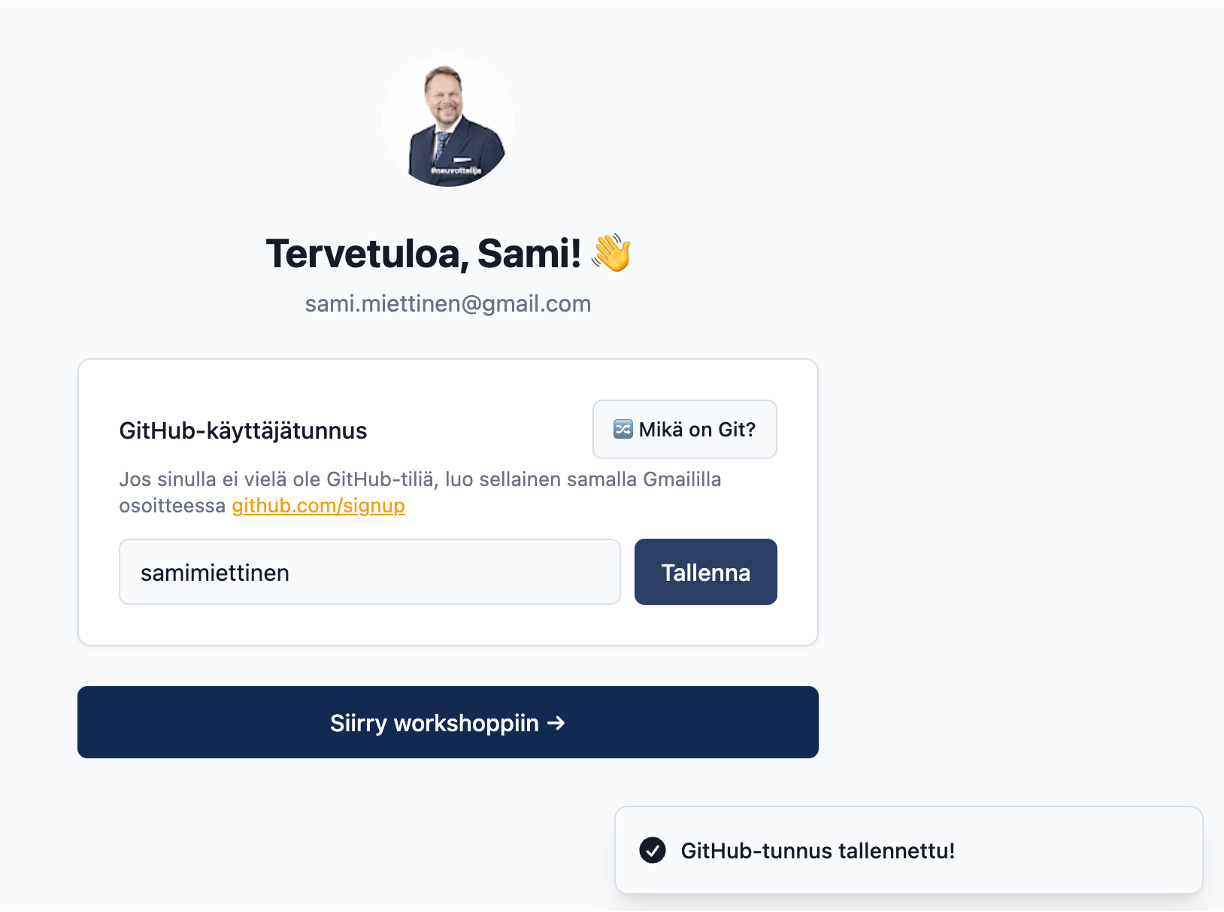
The demo started with identity and ownership. A participant first supplied a Gmail address. The next screen asked for a GitHub username and, when needed, directed the participant to create a GitHub account with the same Gmail address before returning to save the username. The demo did not create the external account itself. Once the GitHub identity was recorded, the participant could enter the workshop group and receive a repository of their own.
Step 1: the demo connected the participant’s Gmail identity to a GitHub username. This publication screenshot deliberately shows my own details, not a participant’s.
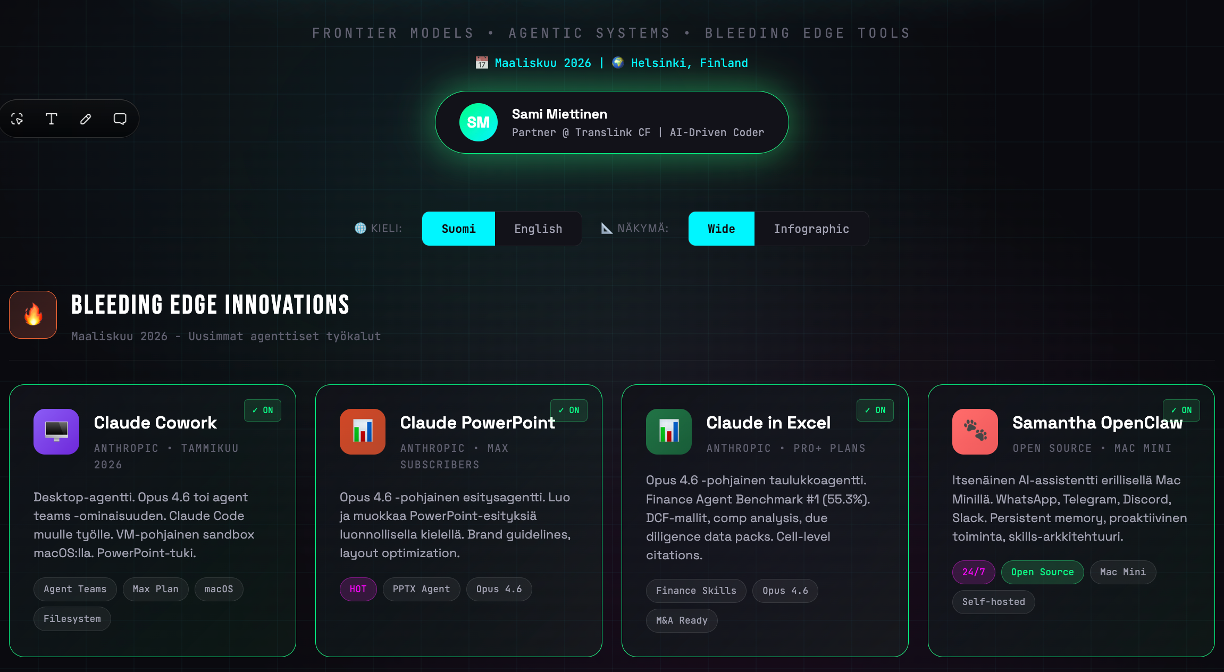
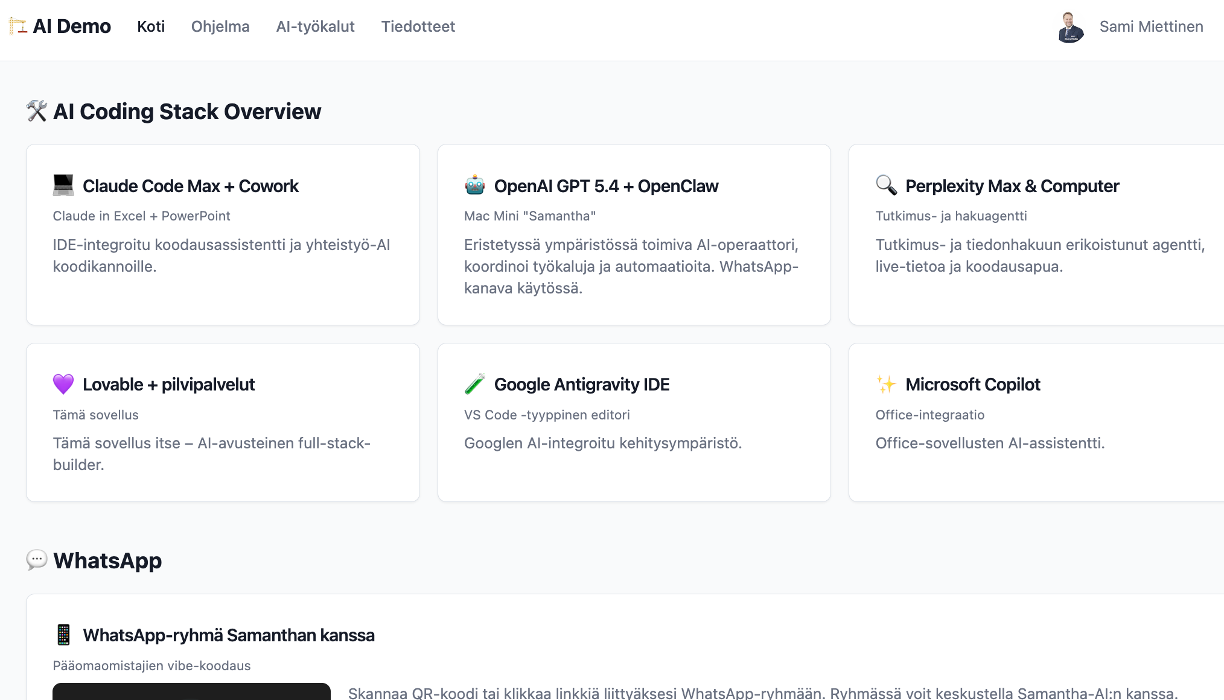
Inside the group, I walked through what now looks like an endearingly bleeding-edge March 2026 stack. It included Claude Cowork and Claude’s coding and office tools, Lovable and cloud services, Google Antigravity, Perplexity, Microsoft Copilot and Samantha, an OpenClaw assistant running on a Mac mini. This is a dated workshop snapshot, not a current tool ranking or procurement recommendation.
Step 2: the group reviewed the then-current frontier and agentic stack, including Claude Cowork and Samantha OpenClaw.The workshop application linked the tools to a shared group with Samantha. The screenshot contains no participant messages or invitation code.
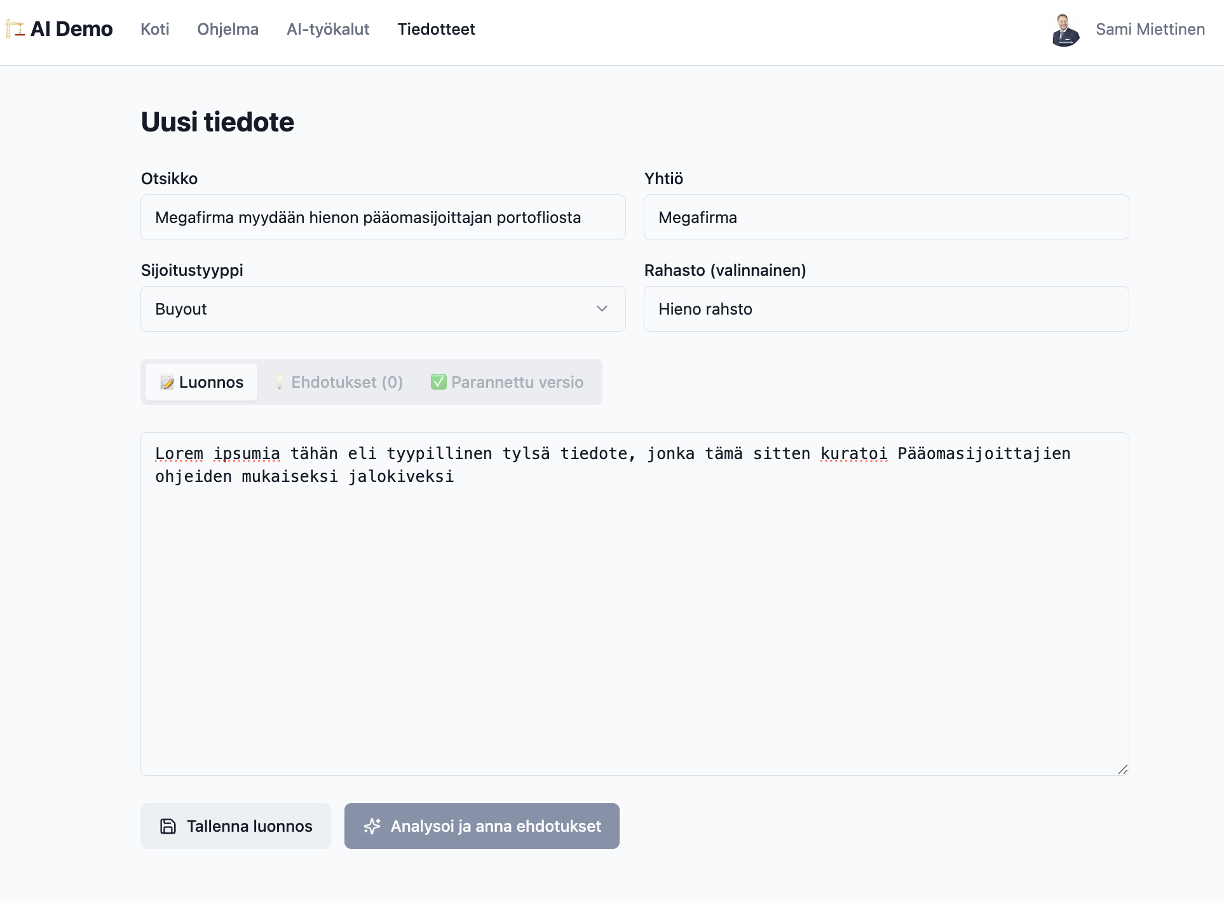
The process then moved from tools to editorial work. Participants took a real press release and examined how its headline, evidence, context and calls to action could be improved against Pääomasijoittajat’s communications guidance. The public screenshot below uses “Megafirma” and placeholder copy instead of exposing the real company draft. Its three-stage interface — draft, suggestions and improved version — made the editorial changes inspectable before publication.
Step 3: a privacy-safe reconstruction of the real press-release exercise. The tool analyses a draft against Pääomasijoittajat guidance; the published image contains fictional company details and placeholder text.
For me, the important shift was from watching a demonstration to producing something participants could continue developing. A first programme is a starting point, not a production-ready compliance system. Before real use, its owner still needs to verify sources, calculations, permissions and approvals. The specific FVCA materials used in the session should be checked against their applicable version; the separate Invest Europe references above are not a substitute for those materials.
AI can help structure drafts, identify missing sections and turn a reporting routine into a repeatable workflow. It must not invent portfolio values, investor commitments or assurances of compliance. Keep confidential investor and company information out of public repositories, review changes before merging them, and retain a human decision-maker for publication.
## Questions to take into your next meeting
For founders: Why this investor, and why now? How much financing enters the company? What happens if the plan misses its first-year targets? Who can help recruit and internationalise? What are the actual governance and exit terms?
For fund investors: Which outcomes came from operational improvement rather than valuation changes? How are realised and unrealised results separated? Are the cash-flow timing, costs and valuation assumptions understandable? Can the manager explain setbacks with the same clarity as successes?
For communications teams: Can every material statement be traced to a source? Are the definitions consistent across reports? Is the approval process explicit? Can a colleague reproduce the output without relying on one person’s memory?
Private equity works as an idea when capital and ownership capability are brought together. It works as a practice only when the promises can be tested against decisions, execution and evidence. That is also the standard I apply to AI-assisted investor relations.
*Educational editorial analysis, not personalised investment, legal or tax advice. Sources checked 13 September 2026. Interview themes and chapter times: supplied Finnish and English episode descriptions. Workshop outcomes: Sami Miettinen’s account.*
---
Cite as: Sami Miettinen, Neuvottelija — Private equity in Finland: active ownership, growth and AI-assisted investor relations, https://www.neuvottelija.com/guides/private-equity-finland-active-ownership-and-ai/, 2026-09-13.